BKT
Overview
BKT is a tree structure designed for discrete distance functions. It chooses a pivot as the root, and maintains the objects having the distance i to the pivot in its ith sub-tree. If a sub-tree contains more than one objects, it selects a pivot at random and partitions the sub-tree recursively. Fig. 1 gives an example BKT. The leaf nodes store the actual objects, while the non-leaf nodes store the corresponding pivots used to partition the sub-trees. Although BKT is designed for discrete distance function, the continuous distance range can be partitioned into discrete ranges used for indexing. For example, if the continuous distance function range is [0, 30], we can divide it into three disjoint ranges [0, 10), [10, 20), [20, 30] in order to simulate the discrete distance function. Hence, BKT can be adapted to support both discrete and continuous distance functions.
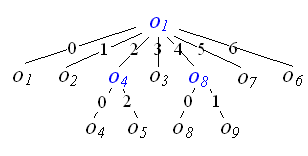
Fig. 1 Example of BKT